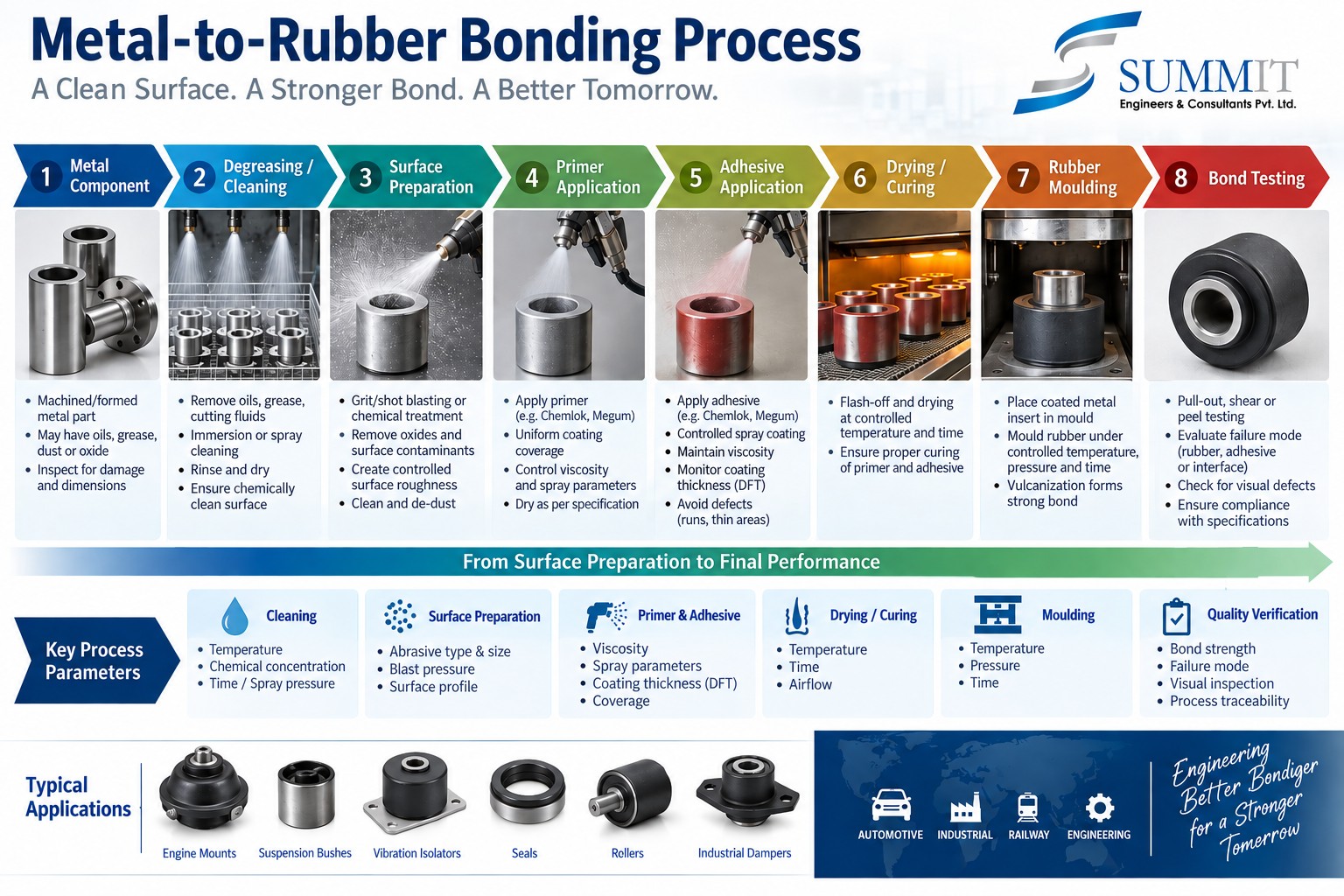
From metal cleaning to reliable rubber-to-metal bonding
Metal-to-rubber bonding is widely used in automotive, industrial, railway and engineering applications such as bushes, mounts, vibration isolators, seals and dampers.
While the rubber compound and adhesive are important, reliable bonding starts with the metal surface. Oil, grease, machining residues, oxides and improper surface preparation can significantly affect adhesive performance.
A controlled metal-to-rubber bonding process can be represented as:
Metal Component → Degreasing/Cleaning → Surface Preparation → Primer → Adhesive → Drying/Curing → Rubber Moulding → Bond Testing
Each stage contributes to the final bond quality.
1. Metal Cleaning Before Rubber Bonding
Machined or formed metal components may carry cutting oils, grease, drawing compounds, rust-preventive oils, dust and metal particles.
These contaminants can prevent proper contact between the metal and adhesive.
Cleaning may be carried out using:
-
Immersion cleaning
-
Spray cleaning
-
Alkaline cleaning
-
Solvent degreasing
-
Ultrasonic cleaning
The correct method depends on the substrate, contamination, component geometry and production requirements.
For automated production, cleaning parameters such as temperature, chemical concentration, cleaning time, spray pressure and bath condition should be controlled.
Cleaning is not the same as surface preparation.
Cleaning removes contamination; surface preparation creates the required condition for reliable adhesive bonding.
2. Surface Preparation and Grit Blasting
After cleaning, metal components may require mechanical or chemical surface preparation.
Grit blasting is commonly used to remove oxides, rust and weak surface layers while creating a controlled surface profile.
Important parameters include:
-
Abrasive type and size
-
Blast pressure
-
Nozzle distance
-
Exposure time
-
Surface coverage
-
Media cleanliness
-
Dust removal
The objective is not simply to make the surface rough. It is to create a consistent and suitable surface condition for the selected bonding system.
After blasting, components should be protected from recontamination before coating.
3. Primer and Adhesive Coating
Rubber-to-metal adhesive systems such as Chemlok® and MEGUM™/THIXON™ typically use specific primer and adhesive technologies depending on the substrate and rubber compound.
The coating process must control:
-
Adhesive/primer viscosity
-
Mixing and agitation
-
Spray pressure
-
Atomization
-
Gun-to-component distance
-
Spray pattern
-
Component rotation
-
Coating thickness
-
Flash-off and drying
For complex or high-volume components, automated spray coating can provide better repeatability than manual application when properly engineered.
4. Why Viscosity and Coating Thickness Matter
Adhesive viscosity is a critical parameter in spray coating.
Changes in viscosity can affect atomization, spray pattern, coating deposition and final film thickness.
Similarly, insufficient coating can result in incomplete coverage, while excessive coating may increase drying requirements and create coating defects.
Therefore, a robust coating system should control:
Viscosity → Spray Parameters → Coating Application → DFT/Coating Weight → Drying
Where applicable, Dry Film Thickness (DFT) or coating weight should be monitored against the validated specification for the particular adhesive system.
5. Drying and Rubber Moulding
After adhesive application, the coated component must undergo the specified flash-off, drying or curing process before rubber moulding.
During moulding, the rubber compound is vulcanized under controlled temperature, pressure and time, allowing the bonding system to establish the required rubber-to-metal interface.
The final result depends on the interaction of:
Metal Surface + Primer + Adhesive + Rubber Compound + Moulding Conditions
6. Bond Testing and Failure Analysis
Final bond quality should be verified using the appropriate test method, such as pull-out, shear, peel, torsional or destructive testing, depending on the component and customer specification.
Importantly, bond strength alone does not tell the complete story.
Failure analysis should establish where the failure occurred:
-
Rubber failure
-
Adhesive/cohesive failure
-
Metal/adhesive interface failure
-
Primer/adhesive interface failure
This helps identify whether the root cause lies in cleaning, surface preparation, coating, drying, adhesive condition, rubber or moulding parameters.
Engineering the Complete Bonding Process
For reliable metal-to-rubber bonding, each individual operation must work as part of one controlled process:
Clean Surface → Correct Surface Condition → Controlled Coating → Correct Curing → Verified Performance
At Summit Engineers & Consultants Pvt. Ltd., we approach rubber-to-metal adhesive coating as a complete process-engineering challenge—not simply as a spray machine application.
Our solutions can integrate surface preparation, primer and adhesive spray coating, viscosity control, component rotation, drying, process monitoring, data logging and quality verification.
From surface preparation to final performance — Summit engineers the process, not just the machine.
SEO keywords: metal-to-rubber bonding process | rubber-to-metal bonding | rubber-to-metal adhesive coating | metal cleaning before rubber bonding | grit blasting | Chemlok adhesive | MEGUM adhesive | adhesive spray coating | adhesive viscosity control | DFT coating thickness | bond failure analysis