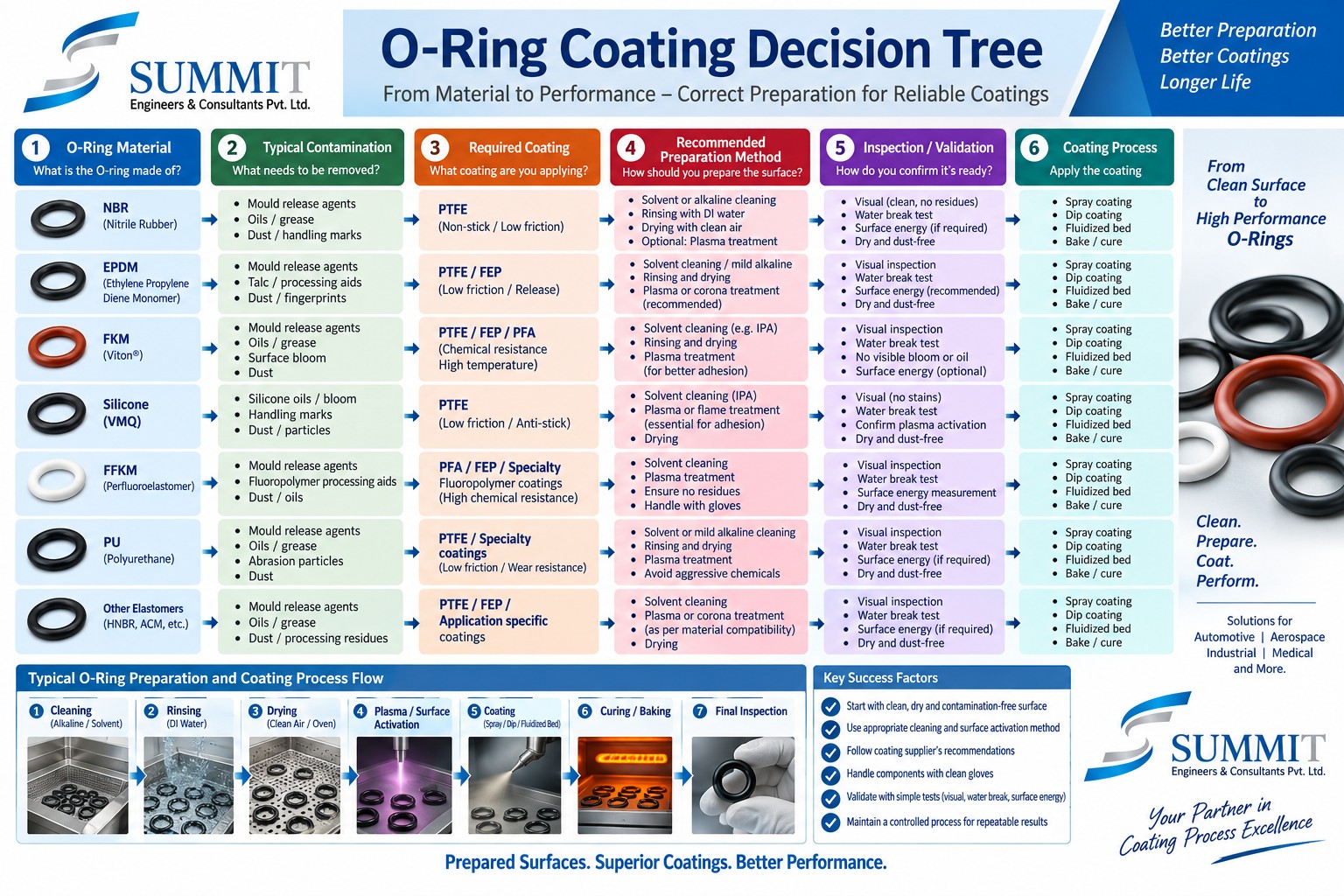
Why Surface Preparation Is the Foundation of Coating Performance
PTFE and specialty coatings are widely used in demanding applications where low friction, release properties, chemical resistance, corrosion protection, wear resistance, electrical insulation, or high-temperature performance are required.
However, even the most advanced coating system cannot compensate for inadequate surface preparation.
In many coating applications, premature peeling, blistering, flaking, poor adhesion, uneven coating thickness, pinholes, and reduced service life can be traced back—not to the coating itself—but to the condition of the component before coating.
Surface preparation is therefore not a preliminary housekeeping operation. It is an engineered process and an integral part of the coating system.
The preparation method must be selected according to:
- Base material
- Component geometry
- Existing surface condition
- Type of contamination
- Coating chemistry
- Required adhesion
- Required surface roughness
- Operating temperature
- Chemical and mechanical service conditions
- Production volume
- Environmental and safety requirements
This article reviews the major methods used for cleaning and preparing components before PTFE and other specialty coatings.
1. Understanding What Must Be Removed
Before selecting a cleaning method, it is important to understand what is actually present on the component surface.
Typical contaminants include:
Organic contaminants
- Cutting oils
- Grease
- Lubricants
- Hydraulic oils
- Fingerprints
- Wax
- Polishing compounds
- Release agents
Inorganic contaminants
- Dust
- Dirt
- Metal particles
- Salts
- Oxides
- Rust
- Scale
Manufacturing residues
- Machining debris
- Grinding residue
- Deburring particles
- Welding residues
- Heat-treatment scale
- Temporary protective coatings
Previous coatings
- Paint
- PTFE
- Powder coating
- Plating
- Adhesive residues
The first principle is therefore:
The cleaning process should be designed around the contaminant—not simply around the coating.
2. Solvent Cleaning
Solvent cleaning is one of the simplest methods of removing oil, grease and other organic contaminants.
The component may be cleaned by:
- Manual wiping
- Immersion
- Spray cleaning
- Circulation
- Vapour degreasing
- Automated solvent cleaning systems
Advantages
- Effective against oils and grease
- Relatively simple
- Suitable for many metallic components
- Can be incorporated into automated production lines
Limitations
Solvent cleaning alone may not remove:
- Oxides
- Rust
- Embedded particles
- Heavy inorganic contamination
- Surface scale
Therefore, solvent cleaning is frequently used as a first-stage cleaning operation, followed by mechanical or chemical surface preparation.
3. Aqueous Alkaline Cleaning
Water-based alkaline cleaners are widely used for removing oils, grease and general manufacturing contamination.
The process normally consists of:
Cleaning → Rinsing → Drying → Surface Treatment
Depending on the system, the component may be cleaned using:
- Immersion tanks
- Spray washers
- High-pressure spray
- Ultrasonic cleaning
- Automated multi-stage washing systems
Advantages
- Suitable for production environments
- Reduced dependence on organic solvents
- Can be incorporated into multi-stage automated systems
- Effective for many common manufacturing contaminants
Important Consideration
The cleaning chemistry must be compatible with the substrate.
For example, aluminium, stainless steel, carbon steel and copper alloys may require different cleaning conditions.
Improper chemistry can result in:
- Etching
- Discoloration
- Corrosion
- Residual deposits
The component must therefore be thoroughly rinsed after cleaning.
4. Ultrasonic Cleaning
Ultrasonic cleaning uses high-frequency sound waves to create microscopic cavitation bubbles in a cleaning solution.
When these bubbles collapse near the component surface, they generate localized mechanical action that helps dislodge contaminants.
This is particularly useful for:
- Small precision components
- Complex geometries
- Blind holes
- Grooves
- Threads
- Internal passages
- Components with difficult-to-access surfaces
Advantages
- Excellent penetration into complex geometries
- Effective for small components
- Can reduce manual cleaning
- Suitable for batch processing
Limitations
Ultrasonic cleaning does not automatically provide the surface roughness or mechanical profile required for coating adhesion.
Therefore:
Ultrasonic cleaning is primarily a cleaning process—not necessarily a surface activation process.
5. Mechanical Cleaning
Mechanical methods physically remove contaminants and unwanted surface layers.
Common techniques include:
- Wire brushing
- Abrasive pads
- Grinding
- Polishing
- Scraping
- Tumbling
- Vibratory finishing
Mechanical cleaning can be useful for removing:
- Rust
- Scale
- Burrs
- Heavy contamination
- Loose oxides
- Previous coating residues
However, care must be taken because aggressive mechanical treatment can alter component dimensions or geometry.
For precision components, the preparation process must therefore be controlled carefully.
6. Abrasive Blasting
Abrasive blasting is one of the most important surface preparation methods for many specialty coating applications.
The process uses a controlled stream of abrasive media to modify the surface.
Typical media include:
- Aluminium oxide
- Glass bead
- Steel grit
- Garnet
- Other application-specific abrasives
Abrasive blasting can perform two functions simultaneously:
1. Cleaning
It removes:
- Oxides
- Rust
- Scale
- Surface contamination
- Existing weak layers
2. Surface Profiling
It creates controlled surface roughness that can improve mechanical anchoring of the coating system.
This distinction is important.
Cleaning removes unwanted material; surface profiling prepares the surface to receive the coating.
The blasting parameters must therefore be controlled, including:
- Abrasive type
- Particle size
- Air pressure
- Nozzle distance
- Nozzle angle
- Exposure time
- Surface profile
- Component material
Over-blasting can be just as undesirable as under-blasting.
7. Grit Blasting vs Glass Bead Blasting
Different abrasives produce different surface characteristics.
Grit blasting
Generally produces a more aggressive surface profile and is often selected when stronger mechanical anchoring is required.
Glass bead blasting
Generally provides a smoother and more uniform finish and may be preferred for applications where an aggressive profile is not required.
The correct abrasive should therefore be selected based on the coating manufacturer’s specification and the substrate.
8. Chemical Etching and Surface Treatment
Certain coating systems require chemical treatment to improve adhesion.
Chemical treatment may involve:
- Acid cleaning
- Pickling
- Etching
- Conversion coatings
- Passivation
- Proprietary surface treatments
These processes can remove oxides and modify the surface chemistry.
However, chemical treatment must be carefully controlled.
Important parameters include:
- Chemical concentration
- Temperature
- Exposure time
- Rinsing
- Neutralization
- Drying
Uncontrolled chemical treatment can damage the substrate or leave residues that adversely affect coating adhesion.
9. Plasma and Atmospheric Plasma Treatment
Plasma treatment is increasingly used for specialty coating and bonding applications.
Plasma can modify the surface energy and remove certain organic contaminants.
It is particularly useful when:
- The component is sensitive to aggressive mechanical treatment
- Very clean surfaces are required
- Surface activation is important
- Complex geometries need localized treatment
Plasma treatment is often considered a surface activation process rather than simply a cleaning process.
10. Flame Treatment
Flame treatment can be used to modify the surface characteristics of certain materials, particularly polymers.
Controlled thermal treatment can increase surface energy and improve subsequent adhesion.
However, flame treatment requires careful control because excessive heat may:
- Distort the component
- Degrade the substrate
- Change dimensions
- Create unwanted surface damage
Its suitability therefore depends strongly on the substrate and coating system.
11. Laser Cleaning and Surface Preparation
Laser cleaning is an advanced non-contact preparation method.
A controlled laser beam interacts with contaminants or surface layers and removes them without requiring conventional abrasive media.
Potential applications include:
- Removal of oxides
- Removal of paint
- Removal of oil or contamination
- Selective surface preparation
- Precision treatment of localized areas
Laser cleaning can be attractive where:
- Abrasive contamination is undesirable
- High precision is required
- Automated processing is required
- Selective treatment is necessary
It can also provide excellent process control when integrated with automation and inspection systems.
12. CO₂ / Dry-Ice Cleaning
Dry-ice blasting uses solid CO₂ particles accelerated toward the surface.
The particles impact the contamination and sublimate after impact.
Advantages include:
- No conventional abrasive residue
- Reduced secondary waste
- Non-conductive cleaning medium
- Useful for certain delicate components
However, dry-ice cleaning should not automatically be considered a substitute for surface profiling.
If the coating requires a specific surface roughness, a separate surface preparation operation may still be necessary.
13. Cleaning and Surface Profiling Are Two Different Steps
One of the most common mistakes in coating preparation is treating cleaning and surface preparation as the same activity.
They are not.
A component may be:
Visually clean but unsuitable for coating.
For example, a component may have no visible oil or dirt but still contain:
- Oxide layers
- Inadequate surface profile
- Embedded contaminants
- Residual salts
- Poor surface energy
- Fingerprint contamination
A robust coating preparation process therefore normally considers at least four stages:
Stage 1 – Cleaning
Remove oils, grease and contaminants.
Stage 2 – Surface Conditioning
Remove oxides, scale or previous surface layers.
Stage 3 – Surface Profiling / Activation
Create the required physical or chemical condition for adhesion.
Stage 4 – Final Cleaning
Remove dust, abrasive particles and residues immediately before coating.
14. Final Cleaning Before Coating
After surface preparation, the component should be handled carefully.
The prepared surface should not be touched with bare hands.
Possible final cleaning methods include:
- Clean dry air
- Vacuum cleaning
- Solvent wipe
- Clean-room compatible wipes
- Filtered compressed air
The objective is to prevent re-contamination immediately before coating.
This is particularly important for high-performance specialty coatings.
15. Component Handling Is Part of Surface Preparation
Surface preparation does not end when the blasting or cleaning machine stops.
Handling can reintroduce contamination.
Recommended practices include:
- Use clean gloves
- Avoid touching critical surfaces
- Use dedicated fixtures
- Protect prepared surfaces from dust
- Minimize time between preparation and coating
- Use clean storage containers
- Avoid mixing cleaned and uncleaned components
For automated coating lines, the transfer system itself should be designed to minimize contamination.
16. Drying and Moisture Control
Moisture can become a significant problem in coating preparation.
After aqueous cleaning, components must be properly dried.
Potential problems include:
- Flash rust
- Water marks
- Residual moisture
- Poor coating adhesion
- Blistering
- Surface contamination
For sensitive applications, drying may be carried out using:
- Heated air
- Hot-air circulation
- Controlled ovens
- Vacuum drying
- Filtered compressed air
The drying method should be compatible with the substrate and coating system.
17. Inspection Before Coating
A well-designed coating process should include inspection before the coating operation.
Depending on the application, inspection may include:
Visual inspection
Check for:
- Oil
- Dust
- Rust
- Stains
- Uneven preparation
Surface roughness / profile measurement
Where specified, the surface profile should be measured using an appropriate instrument.
Water-break test
Useful in certain cleaning processes to identify residual hydrophobic contamination.
Contact-angle / surface-energy assessment
Can be useful for specialized applications where surface activation is critical.
Cleanliness verification
For critical applications, objective cleanliness verification may be incorporated into the process.
18. Selecting the Right Preparation Process
There is no single universal cleaning method for PTFE or specialty coatings.
A practical selection matrix can look like this:
|
Contamination / Requirement |
Typical Process |
|
Oil and grease |
Solvent / alkaline cleaning |
|
Light dust |
Air / vacuum cleaning |
|
Heavy oil |
Alkaline or solvent cleaning |
|
Rust |
Abrasive blasting / chemical treatment |
|
Oxides |
Abrasive or chemical treatment |
|
Scale |
Mechanical / abrasive treatment |
|
Complex small components |
Ultrasonic cleaning |
|
Surface profiling |
Abrasive blasting |
|
Surface activation |
Plasma / specialized treatment |
|
Precision localized cleaning |
Laser cleaning |
|
No abrasive residue desired |
Dry-ice / laser cleaning |
|
Polymer surface activation |
Plasma / flame treatment, where suitable |
The final process should always be validated against the specific coating manufacturer’s requirements.
19. A Typical Industrial Preparation Sequence
For many metallic components, a typical process architecture may be:
Incoming Component
↓
Visual Inspection
↓
Pre-Cleaning / Degreasing
↓
Washing
↓
Rinsing
↓
Drying
↓
Abrasive Blasting / Surface Conditioning
↓
Dust Removal
↓
Final Cleaning
↓
Inspection
↓
Masking
↓
Coating
↓
Curing / Baking
↓
Final Inspection
The exact sequence will vary depending on the coating technology and substrate.
20. Automation of Component Preparation
As coating production volumes increase, manual preparation can become a significant source of variation.
Automation can be introduced in:
- Washing
- Degreasing
- Ultrasonic cleaning
- Blasting
- Drying
- Component handling
- Masking
- Coating
- Curing
- Inspection
Automation offers important advantages:
- Repeatability
- Controlled process parameters
- Reduced operator dependency
- Traceability
- Improved productivity
- Better process consistency
For high-volume applications, the objective should not simply be to automate the coating machine.
The entire preparation-to-coating process should be considered as one integrated manufacturing system.
21. The Importance of Process Windows
Every preparation process should have defined operating limits.
For example:
Cleaning
- Chemical concentration
- Temperature
- Time
- Bath condition
Blasting
- Abrasive specification
- Pressure
- Nozzle distance
- Exposure time
- Surface profile
Drying
- Temperature
- Time
- Air quality
Final cleaning
- Solvent specification
- Wipe method
- Handling requirements
Defining these parameters converts surface preparation from an operator-dependent activity into a controlled manufacturing process.
22. Special Consideration for PTFE Coatings
PTFE coatings are often selected for their:
- Low coefficient of friction
- Non-stick properties
- Chemical resistance
- Temperature resistance
- Release characteristics
But these properties do not eliminate the need for proper substrate preparation.
Depending on the coating system, the preparation may involve a combination of:
Degreasing + Abrasive Preparation + Cleaning + Primer / Surface Treatment + Coating
The exact system should always be established from the coating supplier’s technical data and validated through trials.
23. Specialty Coatings Require Application-Specific Preparation
The term “specialty coating” covers a very broad range of technologies.
These may include:
- PTFE
- FEP
- PFA
- ETFE
- Epoxy
- Polyurethane
- Ceramic coatings
- Anti-friction coatings
- Anti-corrosion coatings
- High-temperature coatings
- Electrical insulation coatings
- Dry-film lubricants
Each system can have different requirements.
Therefore:
Surface preparation should be specified as part of the coating system—not as an independent cleaning activity.
24. The SUMMIT Approach: Preparation as Part of the Coating System
At SUMMIT Engineers & Consultants, we believe that a coating machine should not be considered in isolation.
The complete process includes:
Component → Cleaning → Surface Preparation → Masking → Coating → Drying/Curing → Inspection
The objective is to develop a stable and repeatable process rather than simply apply a coating.
Depending on the application, SUMMIT can engineer solutions incorporating:
- Automated component handling
- Spray coating systems
- Dip coating systems
- Roller coating systems
- Cleaning systems
- Drying systems
- Curing ovens
- Viscosity and temperature control
- Automated weighing and dispensing
- DFT measurement
- Poka-yoke systems
- Data logging and traceability
This integrated approach helps customers move from trial-based coating to controlled production coating.
Conclusion
The performance of PTFE and specialty coatings begins long before the coating gun starts spraying.
A successful coating process depends on the complete chain:
Clean Surface → Correct Surface Condition → Controlled Coating → Correct Curing → Verified Performance
Different applications may require solvent cleaning, aqueous cleaning, ultrasonic cleaning, mechanical preparation, abrasive blasting, chemical treatment, plasma, laser cleaning or other specialized methods.
The key is not to ask:
“Which cleaning method is best?”
Instead, the better engineering question is:
“What surface condition does this coating system require, and what process will reliably achieve that condition?”
That change in thinking is fundamental to developing reliable, repeatable and scalable specialty coating processes.
Good coating performance starts with good surface preparation.